What is it like to witness the largest drone attack in history?
No, not to witness – to be the target of the largest drone attack in history?
All week we heard the news about Iran’s pending attack. The media headlines came without much on-the-ground, practical instructions for what to do to prepare for such an attack. Sure, there are always the usual instructions – get the bomb shelter ready, put some extra water bottles in there. But the almost blasé attitude about it, not only on the part of the media, but on the part of the populace, inspired a similar reaction in us. Alright, so Iran is going to attack. How much will this delay Pesach cleaning? Will this impact our Seder plans to be in the north of Israel? On both counts, it remains to be seen.
Leading up to Shabbat, we were informed by the news that Iran was expected to attack within the next 24-48 hours. Recovering from sickness, an extreme bout of insomnia, and stressed about Shabbat prep and Pesach cleaning, my mind did not have the bandwidth for this information. “Alright,” I said to myself. “What can I do? I’ll get ready for Shabbat as usual, hope for the best, and try to finally sleep for the first time in weeks. If I’m woken up by an attack, so be it.” Cynicism mixed with exasperation prevented me from fully grasping the gravity of the pending attack.
Shabbat passed peacefully and quietly. I nearly forgot about Iran. All I was thinking about was how behind I am on Pesach cleaning and how I need to cram a bunch of tasks into the upcoming week because I’ve fallen so far behind between the illness and insomnia. David opened the news after Shabbat ended to see what the reports were. Still no updates.
I got busy with some post-Shabbat cleanup and other tasks. David chatted on the phone with a friend. All in all, an ordinary night. Iran was far from my mind.
As David spoke on the phone with his friend, his friend told him that he had just received a text message from a friend who works in intelligence stating that the drones had been launched. This was at around 11:30 PM. The news almost seemed too incredible to believe, like a dream, or a movie.
“Are you sure?” I asked a few times. We checked the news. No updates yet. Surely we should be getting some text messages from the Pikud Oref letting us know about such an event, right? Don’t they send text messages and drop leaflets to Arabs in Gaza to warn them of a pending attack? Could they not bother to do the same for their own citizens when an enemy has launched an attack? These were the thoughts that crowded my mind.
Perhaps around half an hour after hearing this update, we checked the news. Then the reports started coming in – it was confirmed. It was no longer some friend in intelligence warning of a pending attack, it was all over the news. We received some more specific information – the drones would be arriving by about 2 AM. We weren’t exactly in the frame of mind to go to sleep by that point, and I particularly did not want to be woken up by bombs, so talks of going to bed were dismissed.
I had sent up some quick prayers before – the usual, asking for Hashem to protect us, to put a shield around us – but now, prayed in earnest and focused on saying a few chapters of Tehillim. Who knew what to expect? How many drones were coming? Where would they go? What kind of attack would this be? Where would wego? Would Beit Shemesh be hit? Would our little moshav be hit? Should we be prepared to drive off if all hell should break loose and roving bands of Arabs decided to take the opportunity to attack as well? Drive off where? Where could we possibly go?
We quickly tried to locate the מקלט (bomb shelter), since we do not have one in our house. Our landlord had kindly let us know after Shabbat ended that it would be open, but directions were confusing. Behind the Beit Knesset?! Where behind? We ran around looking at doors and trying to figure out where the מקלט was. I was thinking how stupid it was that we were running around outside when the drones could arrive any minute.
In hindsight, I think this is part of the psychological torture of this kind of attack. It wasn’t a surprise. We were warned of it repeatedly by Iran. They even told us around when to expect it. The drones took a few hours to arrive. We knew they were coming. What could we, as simple citizens, possibly do?
In short, we didn’t find the מקלט. We walked around for a few minutes outside looking for it. It was a cool night, quiet aside from the military planes flying overhead occasionally (though perhaps with more frequency this night), as they had been all week. I looked up at the sky. It was bit foggy, but patches of sky and stars were visible. No drones in sight yet.
Shortly after this, we listened to more reports. Not only were drones sent, but missiles too. Now it seemed just a matter of time before they arrived. What to do with ourselves? There was no point in trying to fall asleep – our bodies were in fight or flight mode. It’s impossible to convince the body to relax and fall asleep when we must be ready to run to a shelter of unknown location.
“We’ll see people going when it all starts,” I said, convincing myself. “We’ll find it with Hashem’s help.”
We hoped.
The memories of last night are like a dream. In the moment of the attack, my memory is a complete haze. I didn’t completely black out, because it wasn’t a millisecond of an event, but those last few minutes before the actual attack began and until we got to the shelter, my memory is confused, disjointed, and, I’m pretty sure, not in chronological order. I will recount it as best as I can.
It was around 1:40 AM. We turned on the same livestreaming video we had been checking all evening for updates. The newscaster said something along the lines of, “We’re still waiting.” This is the point where my memory starts to fade, where pure survival instincts kick in.
Right at the moment the newscaster said whatever he said, we heard the dogs in the moshav in uproar. My red alert notifications began pouring in. I think we stepped outside once at this point to look at the sky and try to see if people were going to the shelter. Looking directly above me, a patch of fog had shifted to reveal what looked, if I didn’t know better, to be a large shooting star without a tail. It flew quickly and far above us and was extinguished into blackness.
I turned back inside quickly. The questions began. What do we do? What do we do? That was a drone, I was sure of it. There had only been one. Where were the others?
After this, it was perhaps a few more minutes before we heard the loud booms. We’ve heard plenty of booms from Gaza before – this was something else, much closer, much louder. Too close for comfort.
At this point, out of pure confusion, we stepped out front again. This is an image I will never forget. One drone had been scary enough, but this was something else entirely. I saw three? Four? Five? absolutely massive flaming objects with long, thick tails of smoke rising into the air from behind the buildings of Beit Shemesh, which we face, headed in our direction. Our front yard faces west, and we are not far from Jerusalem. I can only surmise, after looking at the red alerts afterward, that these were missiles headed to the Jerusalem area (or perhaps the Gush/Shomron). David, who was not looking across at Beit Shemesh like I was, told me afterward that at that point, he was looking up at the sky above us – and saw several drones flying above.
We both ran back in. The booms were loud, close, and frequent. What do we do? What do we do? Get away from the windows. Get down to the floor. By the stone wall with no windows. But what about the מקלט? Wouldn’t it be better there? David tries to call our landlord to ask where it is. I call our neighbor because he had mentioned to come to their mamad (their in-house bomb shelter) in case of emergency. Is he even awake? Where is his front door?
We heard voices outside. “People are going to the מקלט,” I said. “Let’s go.”
At this point, we still had not heard any sirens, which presumably meant that there were no missiles, bombs, or shrapnel falling in our area. We ran outside and went in the direction of the Beit Knesset and the voices. Finally, someone was there opening the door. We ran in.
The booms had stopped by the time we got to the מקלט, but the questions remained. Would there be more? How many? Would this last all night? Mixed reports on the news said more missiles were on the way. A few trips back to the house to grab pillows and a fold-out mattress ultimately ended up being pointless, at least for that night, but we were not ready to try to sleep in our house, only to be awakened by another barrage and forced to run back out. I couldn’t sleep. I watched the news for more updates.
At long last, it seemed to be that at least for this night, the attack was over. We went back to our house. I fell asleep around 5 AM and dreamt of more missiles and drones.
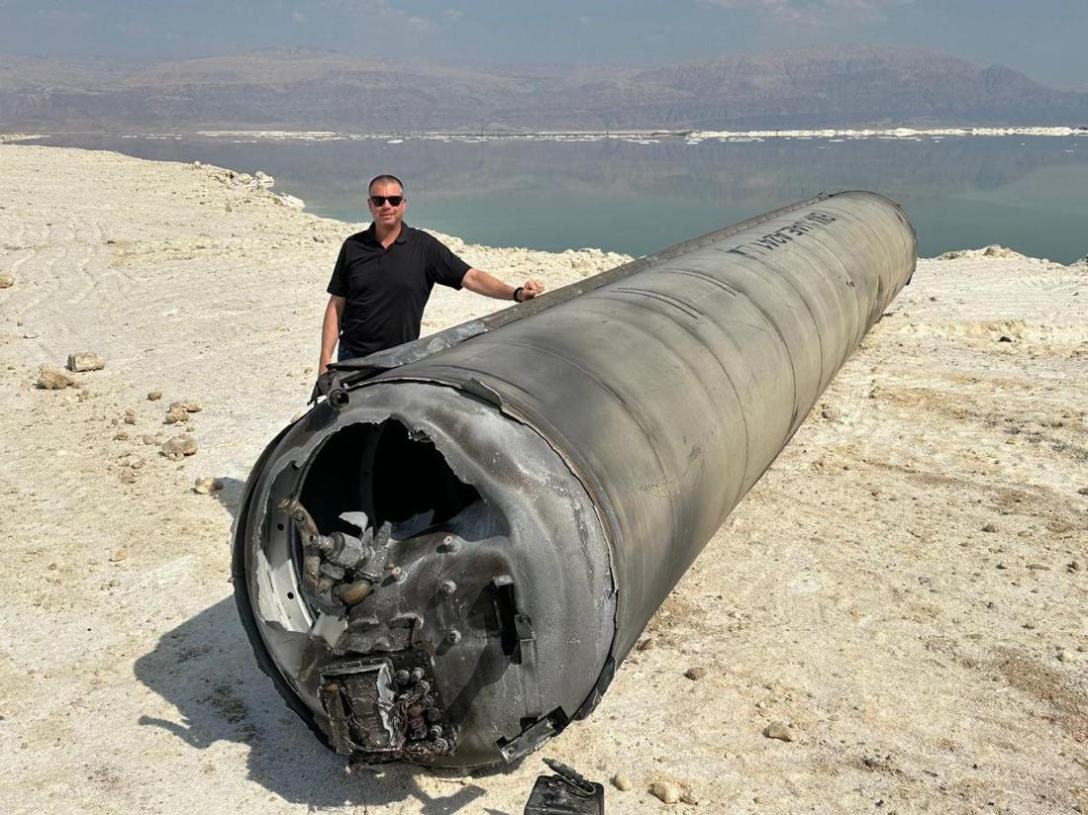
Around 300 missiles and drones were sent in our direction in what is now being called the largest drone attack in history. They were heading straight toward civilian communities in the north, Jerusalem, Gush Etzion, the Shomron, Bik’at HaYarden, and the south. David showed me a picture of an Israeli journalist standing on the beach by a massive shell of a missile, seemingly the size of a gray whale (according to my own amateur estimation).
Israelis were blasé before the attack, a fact which perhaps could be explained by numerous practical factors – for example, the inability for the average citizen to do anything, or perhaps disbelief that Iran would actually launch such a massive attack – but it is incredible to me how blasé people were after the fact. They are reporting that they have returned “back to normal,” extolling the wonders of the Israeli Air Force and technology, attributing the astonishing obstruction of around 300 drones and missiles to these parties. They laugh at Iran’s “ineptitude” and “failure,” joking around about how it was pathetic. “Chametz is scarier than Iran!” Israelis joke.
I’m not quite convinced that Iran was inept or merely failed in its attempts. What should have logically been an extremely deadly and destructive attack appeared merely to be a botched attempt at war – but the reality is that behind it all is our true Protector.
When was the last time you’ve heard of a massive attack of drones and missiles with almost no damage and only one injury? When was the last time you’ve heard of around 99% of missiles and drones being stopped? By all means, recognize the military and technology prowess behind such an incredible prevention – but do not forget our Guard who enabled the success of such an impressive feat. Perhaps people cannot grasp or even notice what a miracle this is due to the sheer magnitude of it.
In a few short days, we will be sitting around the Seder table and reading the Haggadah, as we’ve done for generations. And we will read:
והיא שעמדה לאבותינו ולנו. שלא אחד בלבד, עמד עלינו לכלותינו. אלא שבכל דור ודור, עומדים עלינו לכלותינו. והקדוש ברוך הוא מצילנו מידם.
And it is this [covenant] that has stood for our Forefathers and us. For not just one enemy has stood against us to destroy us. But in every generation there have been those who have stood against us to destroy us, and the Holy One, blessed be He, saves us from their hands.
Vehi She’amda
This was a very real and serious attack, with potentially deadly consequences. It could have easily been a mass casualty incident. We, as a nation, should be profusely thanking G-d and turning to Him. All the technology and military ability in the world cannot bring us a victory; only G-d can. This – our covenant – this is what has stood for our Forefathers and us. It is this that will bring us victory and true peace.
The more we rely on G-d and fulfill His will in obliterating the enemy, striking the enemy before they strike us, the bigger the miracles we will see – and the less we will rely on foreign approval and aid, and the less we will glorify technology and military. G-d is ready to do everything for us. We have witnessed it from the days of יציאת מצריים up until the present, till this very day. But we must call on Him.
These trust in chariots and these in horses, but we – we mention the name of the Lord our God.
Psalm 20:8
May we be humbled enough to recognize that the Holy One, blessed be He, has once again saved us from the enemy’s hands.

 The Singing Soul